Mounting Systems for Thai Roofs: The Part Nobody Looks At
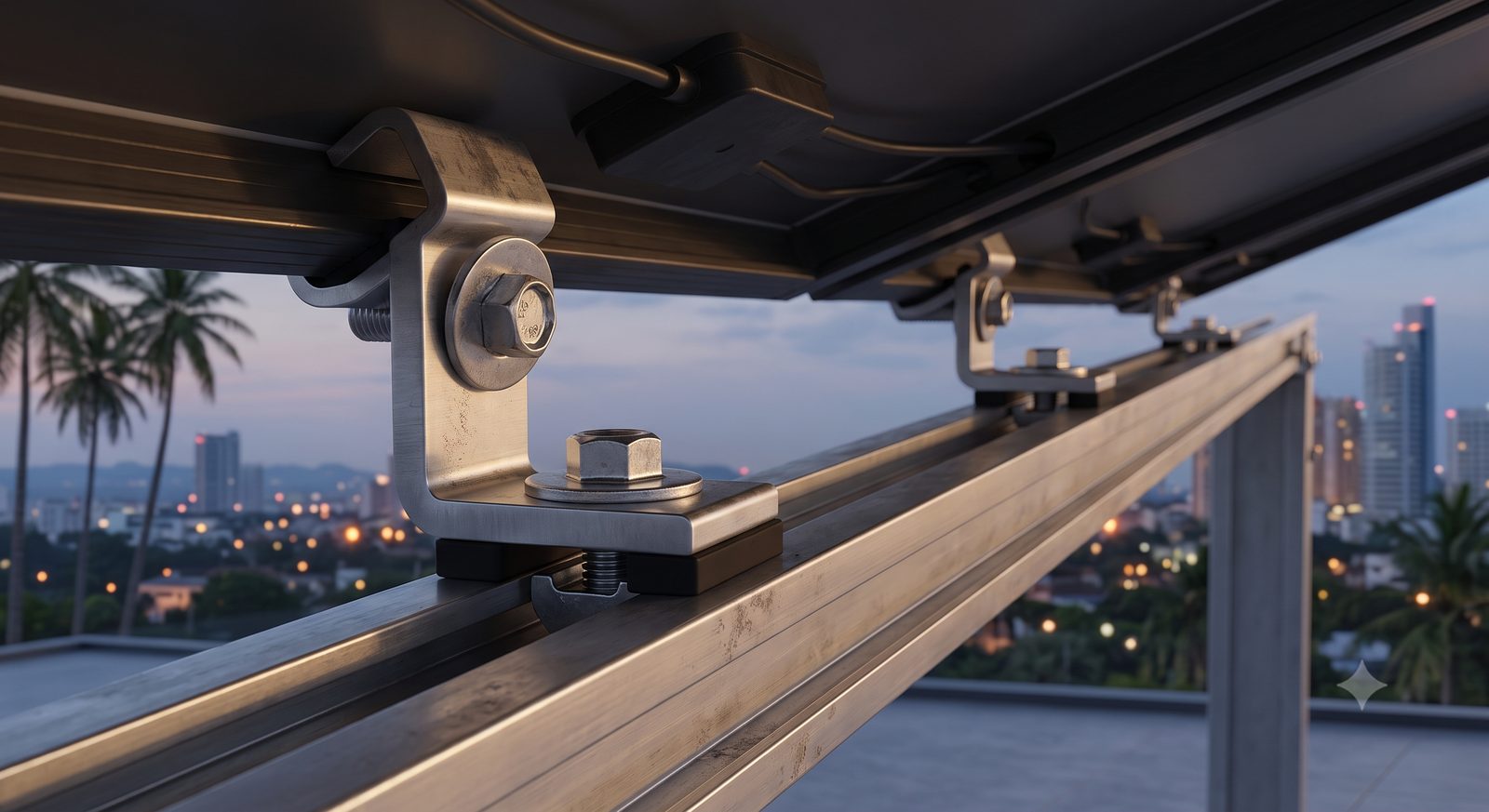
Most guidance on solar mounting is written for Europe or North America and talks about snow load. In Thailand the stresses are entirely different: monsoon wind, relentless UV, heavy rain and, along the coast, salt-laden air. A mounting system that would last thirty years in Germany can fail here in five if the wrong materials are used.
What Actually Attacks a Mount in Thailand
The critical load is not weight pressing down but suction pulling up. Wind flowing over a panel creates lift, strongest at roof edges and corners. Anchor spacing and clamp placement must reflect that - which is why edge rows need tighter fixing than the middle of an array.
Within a few kilometres of the coast - which covers most of Pattaya, Rayong and Chonburi - salt aerosol attacks unprotected metal continuously. Anodised aluminium and stainless steel fasteners are not an upgrade here, they are the minimum.
When dissimilar metals touch in humid, salty air, one of them corrodes rapidly. An aluminium rail bolted with plain steel hardware will destroy itself at every contact point. Correct material pairing costs almost nothing and is regularly ignored.
Aluminium expands and contracts measurably between a 25 degree night and a 70 degree roof surface. Rails need room to move. Rigidly fixed systems work their fasteners loose over the years, and plastic components without UV stabilisation become brittle.
Metal sheet roofs are the most common on industrial buildings and many houses. The best solutions clamp directly to the standing seam without any penetration at all - no hole, no leak, and the roof warranty stays intact. Where penetration is unavoidable, every fixing needs a proper seal, not a bead of silicone.
CPAC and concrete tile roofs are widespread on residential properties. These need a bracket that transfers load into the batten or rafter beneath while allowing the tile above to sit back down naturally. Grinding tiles to force a bracket into place is a common shortcut and a reliable source of leaks.
Flat concrete roofs allow either ballasted frames or anchored feet. Ballast avoids penetration but adds significant weight, so the structure must be verified first. Anchored mounts are lighter but every penetration must be properly flashed and sealed.
Thai Roof Types and What They Need
We developed the NCA mounting range specifically for conditions here: anodised aluminium rails in 2.1 and 4.2 metre lengths, screw-free clamps for metal sheet roofs in several profile widths, dedicated brackets for CPAC tiles and flat roofs, adjustable feet for elevation angles, and grounding brackets that bond the rails properly to earth.
Building our own range means the parts are in stock, they fit each other, and we are not dependent on whatever an importer happens to have on the shelf. It also means that if something ever needs replacing in year twelve, the component still exists.
Our Own Mounting Series
Mounting hardware is typically a small fraction of total system cost, which makes it a tempting place to save a little. It is also the only part of the system that has to hold everything else on your roof through every storm for the next two decades.
How to Judge a Mounting Quote
- Which alloy and surface treatment are the rails, and are all fasteners stainless steel?
- How is the roof penetrated - or is the system penetration-free on a metal sheet roof?
- How are penetrations sealed, and what is the warranty on watertightness?
- Is anchor spacing calculated for wind uplift, and is edge fixing tightened accordingly?
- How is the array grounded, and with which components?
Panels and inverters can be replaced. A mounting system that corrodes, works loose or leaks means opening the roof again - and by then the damage has usually spread beyond the mount itself. Insist on anodised aluminium, stainless fasteners, correct material pairing and penetration-free solutions wherever the roof allows it.
Questions about solar for your property?
Our experts are ready to help with a free consultation and personalised savings analysis.
Contact Our Experts →